



AI makes it cheaper to build software. But it also makes it cheaper to maintain open source. Sometimes. That second part matters more than the first.
When something breaks
I use an early-stage open source automation tool called Gas Town. It breaks regularly. When it does, I fire up a coding agent, point it at the bug, and submit a PR.
I've made dozens of contributions to that project. Not because I'm deeply familiar with the codebase (though I'm getting there), but because it takes a small amount of time to describe the problem, dispatch an agent and test that it works.
I've had the skills to do this for decades, but rarely have due to the time constraints. I'd have to care a whole lot to down tools, and code a fix by hand.
Now with AI agents the bar to contributing back to open source is a lot lower. It's also fine if the maintainers don't merge my changes because it's never been easier to run my own modified version which makes it work the way I want.
Compare that to a closed-source tool I tried recently. Conductor looks like a nice tool, I'm excited to give it a kick. Downloaded it, hit an error, no way to debug. Filed a support ticket. That software is dead to me now (or at least until they ship a new version or respond to the support ticket).
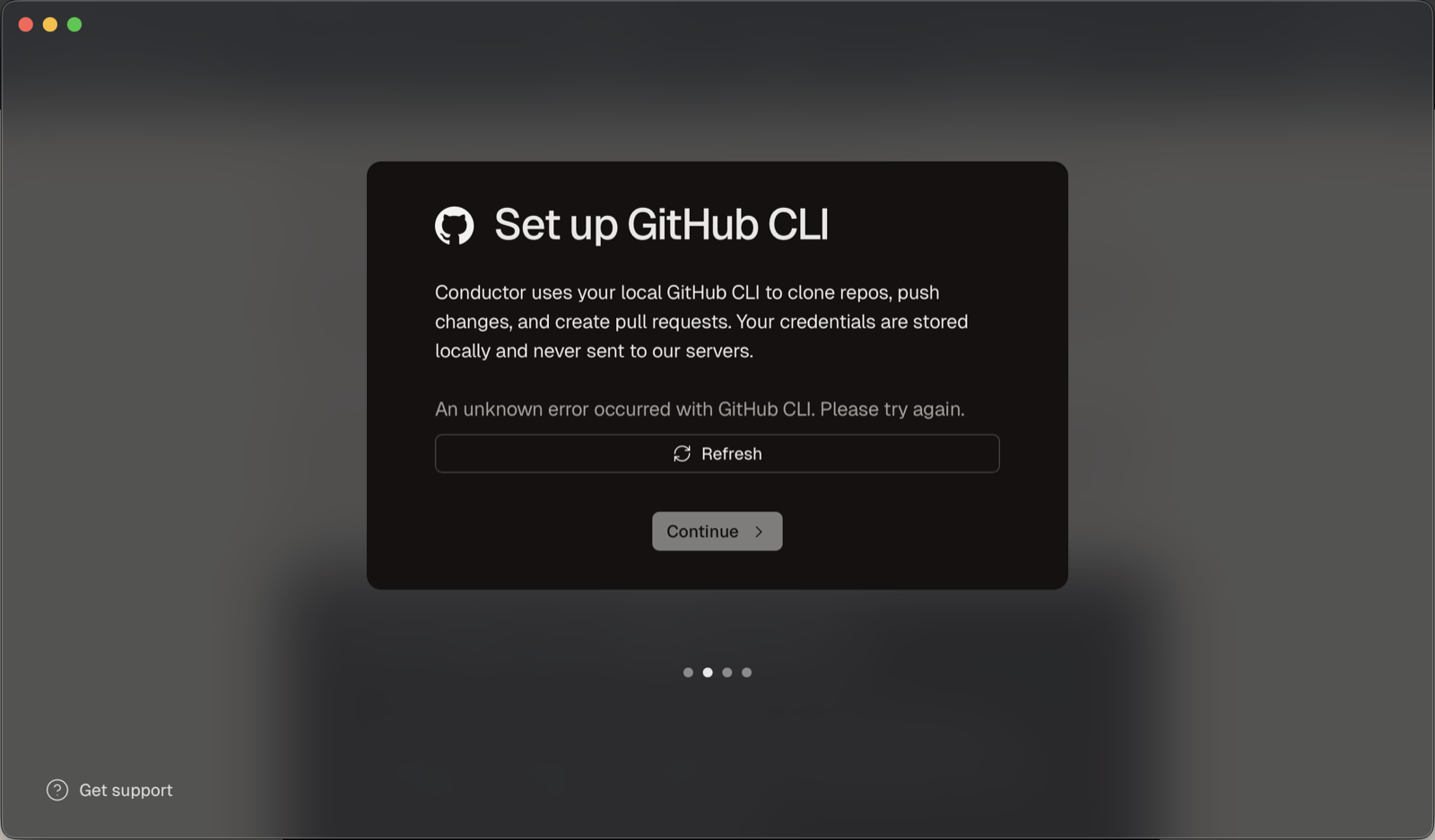 Conductor's setup screen. An unknown error, no way to fix it, no source to read.
The barrier to contributing to open source just dropped from "you need to be a developer" to "you need to describe the problem, and be able to build and test a local version." Still a barrier, but a much lower one. And the cost to contribute for everyone with enough skills is way lower than it used to be.
Sure, lots of people won't want to do that but more people will than have in the past. The skills someone picks up in AI Level Up are enough to start contributing. The equilibrium point between open source and closed source has shifted.
The maintainer divide
This creates a split on the other side too. Some maintainers are using AI to handle the rush. Steve Yegge, 12 days after launching his open source project Gas Town, had merged over 100 PRs from nearly 50 contributors.
His approach: a "PR Sheriff" agent that automatically reviews code changes from contributors, merges the easy wins, and flags the rest for human review. "How can I keep up this maintainer pace without breaking a sweat?" he wrote. The answer is he uses Gas Town.
Others are fighting a different problem. Daniel Stenberg, who maintains curl, recently shut down curl's bug bounty program because of what he calls "mind-numbing AI slop." The rate of confirmed vulnerabilities dropped from over 15% to below 5%. Not even one in twenty was real.
Curl hasn't seen this problem with GitHub PRs. Stenberg says they have "much better means to sort out the weed" for code contributions, with tools, tests and scanners. The slop is concentrated where there's a financial incentive to submit. Bug bounties put a price on reports, and AI made it trivially cheap to generate plausible-looking ones. Take the money away and the noise drops.
It's a useful distinction. The "every user becomes a contributor" dynamic works differently from "every user hunts for security bounties." One is driven by people who use the software and want it to work. The other can be driven by people chasing payouts.
The Tailwind problem
Widespread AI usage can also mess with the economics of open source.
Tailwind CSS is more popular than ever. 75 million monthly npm downloads. And yet in January, Tailwind Labs laid off 75% of its engineering team because revenue dropped roughly 80%.
The reason is simple. Tailwind's business model relied on developers visiting the docs, discovering the paid products (Tailwind UI, component templates), and buying. AI broke that model.
When you ask your coding agent "add responsive padding in Tailwind," it answers directly. You never visit tailwindcss.com. You never see the paid products. The documentation traffic that funded the business dropped 40% while usage kept climbing.
More users, more value, less money. A similar thing is happening to Wikipedia and news organisations.
None of this means open source is dying. But it sharpens the picture. AI makes open source more valuable to users while hollowing out some of the funnels that funded it.
The old model, where docs traffic led to discovery which led to paid products, depended on human attention flowing through a website. AI routes around that completely.
The projects that thrive will be the ones that find funding models closer to usage, not learning. Sponsorships, paid hosting, support tiers, governance. The ones that relied on being a waypoint on a developer's Google search are in trouble. It's a real transition with real casualties, and Tailwind is the canary.
Corporate sponsorship probably hasn't been affected by AI in the same way. After Tailwind's layoffs, Vercel, Google AI Studio, and several other companies stepped up as sponsors.
Crypto is not the answer
The less hopeful version is crypto. When Yegge launched Gas Town, someone created a $GAS token on bags.fm, a Solana launchpad where anyone can mint a token in someone else's name. The creator earns 1% of all trading volume. Yegge reported earning close to $300k from trading fees. Another open source developer, Geoffrey Huntley, received similar amounts from a token called $RALPH tied to his work.
Both tokens crashed. $RALPH hit a $58 million market cap, then lost 96% of its value after on-chain data showed Huntley selling $245k worth of tokens. He called it "de-risking." $GAS peaked at $57 million and fell to around $500k. The money that reached the developers came from speculators who lost most of theirs.
This isn't a funding model. It's a slot machine where the developer is the jackpot graphic. The money doesn't come from people who use the software. It comes from people betting on price movement, and most of them lose.
As Sean Goedecke wrote, it's "orders of magnitude less efficient than just donating money directly." Not every developer wants in, either. When crypto speculators launched tokens tied to OpenClaw, creator Peter Steinberger shut it down flat: "I will never do a coin. No, I will not accept fees. You are actively damaging the project."
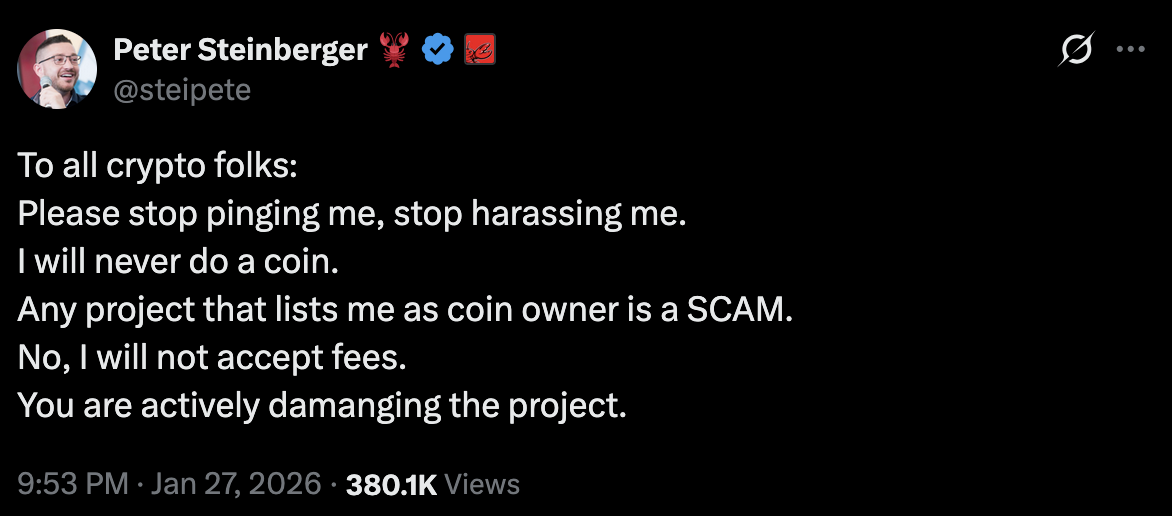 Peter Steinberger's response to crypto speculators launching tokens tied to his open source project.
I'm glad Steve and Geoffrey got funded for their open source work. But I agree with Sean Goedecke — if open source funding needs to be reinvented, crypto token launches are not the answer.
The long tail
Personal example: I'd been having a persistent problem with Playwright MCP servers where it wouldn't work when running multiple agents in parallel. Spent a bit of time hunting for a different configuration but no luck. Old me would have said "I could spend a whole Saturday on that." Instead, while doing other work, agents built browserplex in parallel.
Solved my problem. Also got some new features inspired by Agent Browser and went about my day with a little more software behind me. One more open source project in the world. Cost: conversation time while doing other things.
I wouldn't be surprised if I'd spent (a lot?) more time learning about my original tool I could have gotten it to do what I wanted. Or if I'd spent longer searching I could have found a tool someone else with the same problem had built. But it was less time for me to build it just the way I wanted than to do the searching.
Small tools that scratch a specific itch, built and shared in the time it used to take just to evaluate existing options. My prediction: for utilities, tools, integrations, personal infrastructure, we're going to see a ton more of this. Not replacing the big projects like Linux or PostgreSQL. Filling in the long tail. Every specific problem gets a specific solution, because the cost to create one dropped by an order of magnitude.
What happens to discoverability when there's 100x more projects? Does quality go up because there are more attempts, or down because there's less curation? How do the big critical projects adapt to a world where both contributions and noise scale together?
I also expect aggregate open source contributions to go up. Tools like Claude Code have helped a ton of novices learn what the terminal even is. And from there it isn't much of a step to "here's how you clone a repo and contribute to it." The path from "person who has never opened a terminal" to "person who submits a PR" just got a lot shorter.
How to actually do it
If you want to start contributing to open source with AI, here's what I'd recommend. Stan Lo, a Ruby committer who maintains several core libraries, wrote a good post on this from the maintainer's perspective. His advice lines up with what I've found works.
Treat your agent like a teammate, not a vending machine. Stan suggests treating AI "as another person who's also new to the codebase." Have discussions together, run experiments together. Don't just paste an error and ship whatever comes back.
Review your own work before submitting. The fastest way to get ignored by a maintainer is to submit something you clearly haven't read yourself. If you wouldn't put your name on it without the agent, don't put your name on it with one.
Understand what you're submitting and why. You don't need to understand every line. But you should be able to explain the problem, why your fix addresses it, and what you tested. If you can't, you're not ready to submit.
Start with your own problems. The best contributions come from scratching your own itch. If a tool you use breaks, fix it.
Add an AGENTS.md or CLAUDE.md to your own projects. If you maintain open source, help the agents help your contributors. Include build instructions, test commands, and project conventions. It's a small file that makes a big difference.
AI is a multiplier, not a magic wand. It won't turn someone who doesn't care into a good contributor. But for people who care and have limited time, it removes the biggest obstacle: the hours it takes to understand an unfamiliar codebase well enough to fix one thing.
If you want to follow along as I explore this stuff out in public, you can get my newsletter here.